
Diari · Renda Wedding House
Planning a Malay Wedding in Singapore: The Complete Guide
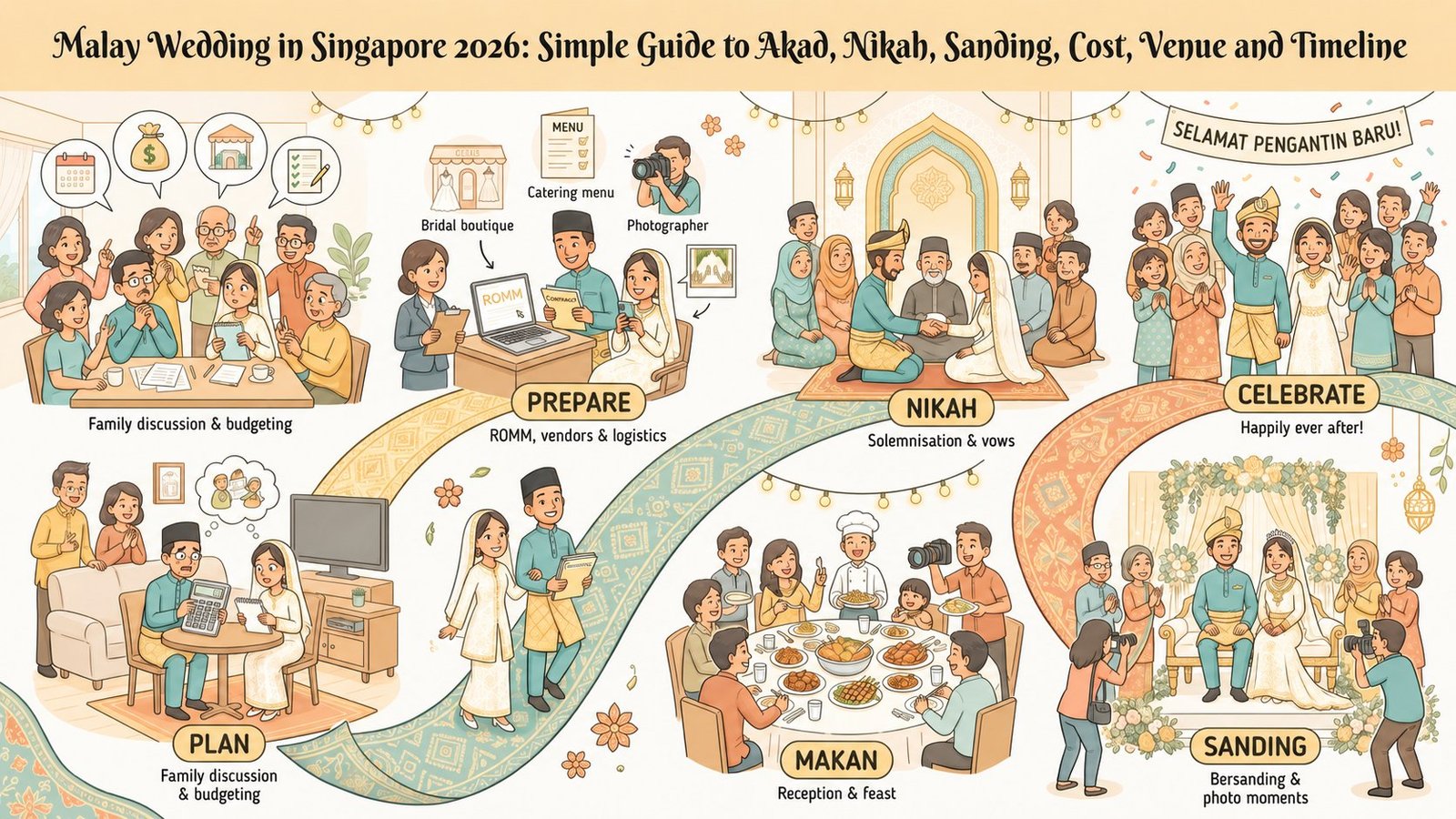
The short answer: a Malay wedding in Singapore usually has the akad nikah as the religious solemnisation, followed by a family celebration, a meal, a bersanding, or a full majlis. The shape can be small or grand. What matters is that the nikah is handled properly, the family adat is respected, the food is halal, and the day flows well for the couple and both families.
If you are starting to plan and suddenly everyone has an opinion, welcome; that is normal. A Malay wedding is not only decor and outfits. It is faith, family, the meal, timing, respect, adat, guest flow, and a long list of small decisions. The goal is not to do everything. It is to keep what matters and carry it properly. This guide gives you the simple version, the Singapore way, and points you to the deeper pieces as you go.
What a Malay wedding here usually involves
A Malay wedding in Singapore is a Muslim marriage with Malay family adat around it. Depending on the family, it can include the early merisik or family discussion, the bertunang or engagement, the hantaran, the ROMM process, the akad nikah itself, the mas kahwin, a meal for guests, the bersanding on the pelamin, the kompang or a groom's entrance, the makan beradab, family photographs, and berkat for the guests. Not every family does every step. Some keep it very simple, some hold a full majlis, some combine the nikah and the bersanding in one day, and some split them across two. There is no need to copy anyone else's wedding. The right one respects your faith, your family and your budget.
The heart: the akad nikah
The akad nikah is the main religious ceremony, the solemnisation where the marriage becomes valid. In Singapore, Muslim marriages follow the official process through the Registry of Muslim Marriages, ROMM. The steps include preparing and submitting the marriage application and completing the required sessions or declarations before the solemnisation. The details can change, especially where age, citizenship, marital status or documents differ, so always check the official Muslim marriage process before fixing your plan.
For the ceremony itself, families usually prepare the bride and groom, the bride's wali, two witnesses, the kadi or naib kadi, the mas kahwin, the venue or nikah space, simple decor or a nikah table, family seating and photo timing. Keep the akad calm. This is not the part to rush.
The celebration: the meal and the bersanding
After the akad, families often hold a meal or a full reception. The bersanding is the part many guests picture when they say Malay wedding: the couple sits on the pelamin, receives guests, and the family celebrates the marriage. A full reception may bring the pelamin, guest tables, a halal buffet, the kompang, an emcee, the makan beradab, a family photo session, photography and video, berkat and a coordinator. But you can also keep it smaller. A nikah and makan is a perfectly proper shape for a family that wants a warm, simple, family-focused day. To weigh the options, read akad only, nikah and makan, or full majlis.
The words, explained simply
| Word | Meaning |
|---|---|
| Merisik | An early family visit to show interest |
| Meminang | The formal proposal |
| Bertunang | The engagement |
| Hantaran | Gift trays exchanged between the families |
| Mas kahwin | The obligatory marriage gift from groom to bride |
| Akad nikah | The Islamic marriage solemnisation |
| Wali | The bride's guardian for the nikah |
| Saksi | The witnesses |
| Kadi or naib kadi | The official who solemnises the marriage |
| Ijab kabul | The spoken offer and acceptance of the marriage |
| Pelamin | The decorated dais for the couple |
| Bersanding | The reception moment, the couple seated on the pelamin |
| Kompang | The frame drums for the entrance |
| Makan beradab | The formal meal for the couple and close family |
| Berkat | A small gift for the guests |
| Andaman | The bride's traditional styling and grooming |
Do not worry if you do not know all the words yet. You will learn them as you plan.
The three lanes
It helps to think of weddings in three simple lanes: The Akad, The Hall and The Grand.
The Akad
A small, calm, intimate nikah, often twenty to fifty guests, at home or in a mosque room, with close family, light styling and decor and short photography. This lane is for couples who want the nikah to feel meaningful and unhurried.
The Hall
A proper family majlis in a comfortable space, often a hundred to three hundred guests, the nikah and bersanding in one day, a pelamin, a halal buffet, family photos and a coordinator. This lane is for couples who want the full wedding feeling, but still manageable.
The Grand
A larger family and community celebration, three hundred to five hundred guests and above, in a bigger venue or a blank canvas, with a larger pelamin, a full vendor team, more crew, a bigger food flow and stronger coordination. This lane is for families who need scale without chaos.
You can see these broad lanes on Renda Journeys.
How much does a Malay wedding cost?
The cost depends on the guest count, the venue, the food, the decor, the styling, photography, video, crew and the date. A small akad can stay lean, a two or three hundred guest majlis needs stronger planning, and a five hundred guest wedding needs serious operations. As a rough feel:
| Wedding shape | Common guests | Budget feel |
|---|---|---|
| Akad only | 20 to 50 | Leanest |
| Nikah and makan | 50 to 120 | Small to mid |
| Intimate bersanding | 100 to 150 | Mid |
| Classic majlis | 200 to 300 | Mid to high |
| Grand majlis | 500 and above | High, operations-heavy |
For how the real number is shaped, read how much a Malay wedding costs in Singapore. The simple advice: decide your guest count first, because almost everything follows from it.
Choosing a venue
The venue has to work for the whole day, not only the photographs. Check whether halal food is allowed or available, whether there is a prayer space or wudhu nearby, and whether there is a bridal room. Check that the elderly can move easily, that the buffet line flows, that vendors can load in, and that there is enough power. Ask when vendors can set up and when everything must be cleared, whether external vendors are allowed, and whether there are noise limits. Singapore Malay weddings happen in many kinds of spaces, a home, a mosque room, a void deck, a community hall, a boutique hall, a hotel ballroom or a blank canvas. For the full list to run through, read the venue checklist.
Halal food and guest care
For many guests, the meal is a major part of the day, and it has to be enough, smooth and halal. Check the caterer's MUIS halal status where required, the kitchen arrangement, the buffet flow, the service crew, the refill timing, elderly-friendly seating, room for children and strollers, the drinks station, and the clean-up plan. MUIS runs halal certification and a certified-establishment search, so always verify the current status before confirming the food.
A simple planning timeline
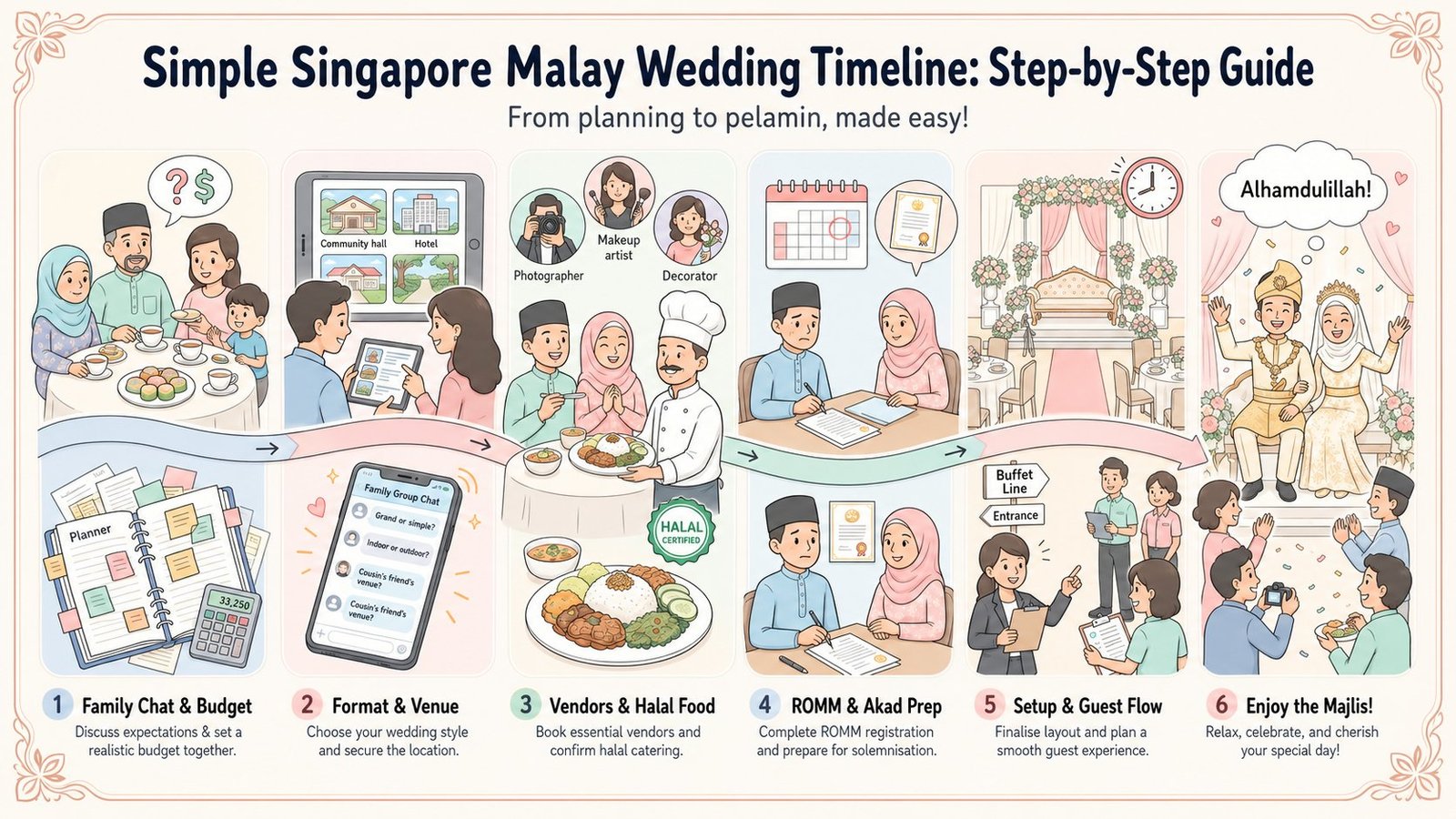
Use this as a guide, not a strict rule.
12 months before
- Discuss the budget with both sides and estimate the guest count
- Shortlist a date or month, and decide the format
- Start the venue search, begin reading up on the ROMM process, and shortlist a wedding house or team
9 months before
- Confirm the venue direction and the main team
- Discuss halal catering and a broad decor direction
- Start the family guest list and plan the akad and reception flow
6 months before
- Prepare or submit the marriage application per the current requirements
- Lock the key vendors, confirm the guest range, and confirm the andaman and media scope
- Confirm a rough floor plan and start outfit planning
3 months before
- Refine the guest list and confirm the menu
- Confirm the pelamin and decor direction, and the timing with both families
- Plan the family photo list and check prayer, wudhu and elderly access
1 month before
- Final guest count, final run sheet, and vendor arrival timings
- Brief the family, confirm the payment schedule, and confirm documents and official steps
- Prepare emergency contacts
The wedding week
- Keep the couple calm, confirm vendor timings and the items list, and confirm family roles
- Sleep if you can, and eat something before the event; many couples forget to, and regret it
A sample one-day flow
A simple shape for a nikah and bersanding in one day.
| Time | Flow |
|---|---|
| 8.00 am | Final setup and andaman |
| 10.00 am | Akad nikah |
| 10.45 am | Family photos |
| 11.30 am | Guests arrive, the meal begins |
| 12.30 pm | Groom arrival, kompang if included |
| 1.00 pm | Bersanding and makan beradab |
| 2.00 pm | Guest greetings and photos |
| 3.30 pm | Last of the guests |
| 4.00 pm | Event close and teardown |
Real timing depends on the venue's rules, solat, the solemnisation slot, your family's needs and the vendor scope.
Keeping the family planning peaceful

The planning turns stressful when everyone talks at once. A few things keep it calm: decide who the final decision-makers are; separate what the couple wants from what the parents need; keep the budget honest; do not invite out of fear alone; write down the non-negotiables and the things you are happy to skip; give both families a clear timeline; and let one person hold the vendor conversation. A Malay wedding is full of love, but love without structure can turn into noise.
What the house can carry
Renda's promise is one house holding the day. That can include the couple's styling and care, the space with its venue, pelamin, decor and room flow, the feast with its halal food arrangement and the flow of the meal, the memory in photo and video, the traditions of adat, kompang, berkat and the family moments, and the day itself, the timing, the coordination and the calm. You can read more on how the house looks after your day.
Common questions
What is the most important part of a Malay wedding?
The akad nikah is the main religious and official ceremony. The reception, the bersanding and the adat can be shaped to suit the family, the budget and your preferences.
Do all Malay weddings need a bersanding?
No. Many families value the bersanding, but not every couple needs a full reception. Some choose an akad only or a nikah and makan.
How many guests should we plan for?
Start with the must-invite family, then close friends and family friends. Do not start from the venue's capacity; start from who truly needs to be there.
Can a Malay wedding be small and still proper?
Yes. A small wedding can be entirely proper when the nikah is handled well, the family is respected, and the guests are cared for.
Do we need a wedding planner or a wedding house?
You can plan it yourself with time and strong family support. A wedding house helps when you want one team to carry the venue, decor, food, media, timing and vendor flow.
Where should we start?
Start with the date, the guest count, the budget, the venue status and the format. Once those are clear, the rest becomes easier.
Useful links
Continue reading from the Diari
Shape this around your own day.
Tell us your date, guest count, venue status and what your family cares about. We will turn it into a clear first proposal, insyaAllah.