
Diari · Renda Wedding House
The Malay Wedding Venue Checklist for Singapore
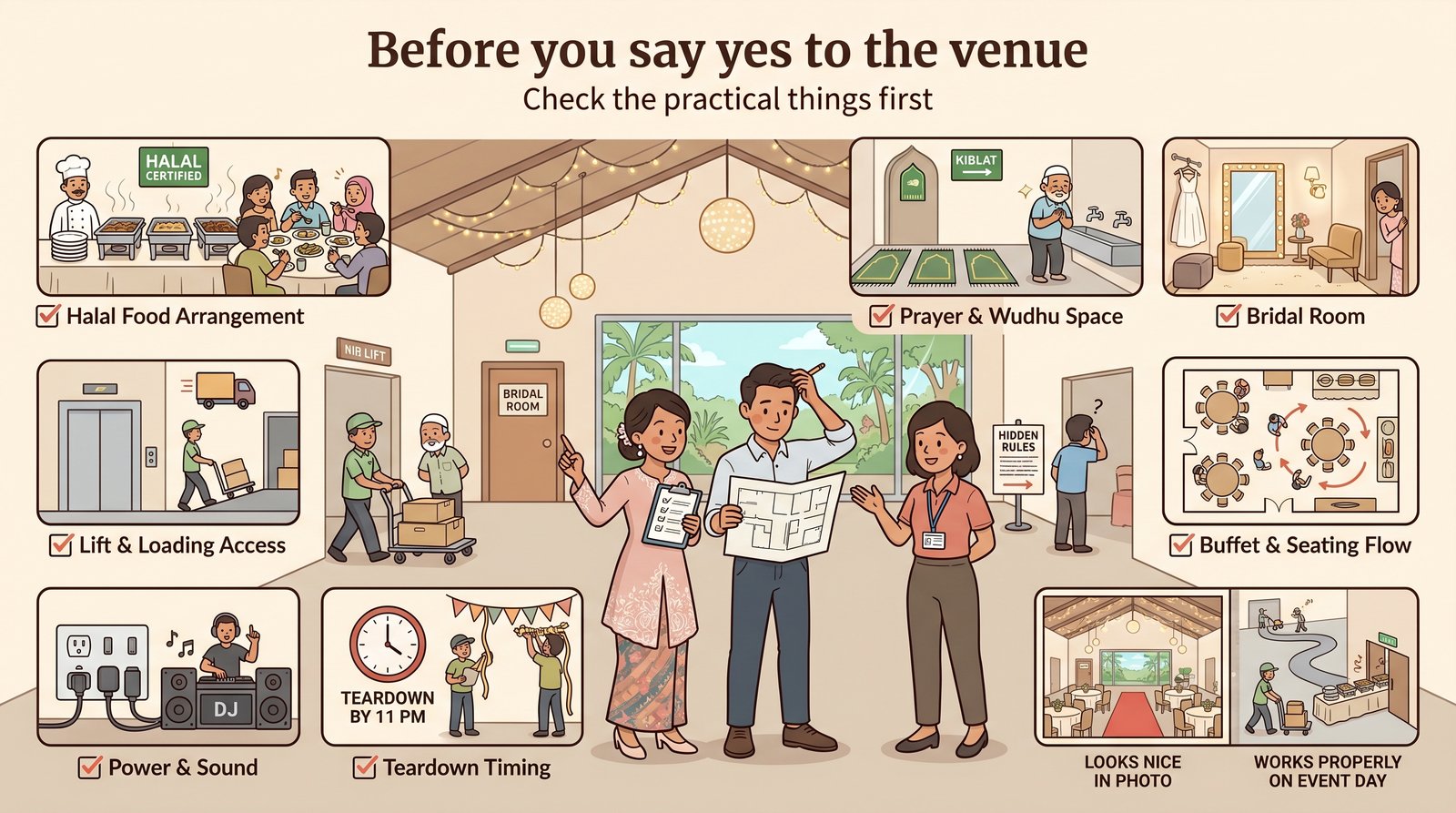
The short answer: a good Malay wedding venue has to work for more than photographs. Before you commit, check the halal food arrangement, prayer and wudhu access, the bridal room, guest seating, the buffet flow, lift and loading, power, water, noise rules, vendor entry and teardown times, and whether an external caterer or decor team is even allowed. The venue shapes the whole majlis, so check that the space can actually carry a Malay wedding before you fall in love with it.
A beautiful room can still turn stressful if the loading bay is far, the buffet line blocks the entrance, the bridal room is tiny, or the venue tells you external halal catering is not allowed after you have already paid a deposit. So before the heart decides, let the checklist decide first. Renda works across many kinds of spaces, from void deck to hall to ballroom, and you can see that broader thinking on Renda Spaces.
The venue types families usually consider
| Venue type | Good for | Watch out for |
|---|---|---|
| Home or family space | A small akad, close family | Space, neighbours, food setup, parking |
| Mosque room or small room | A calm solemnisation | Availability, food rules, decor limits |
| Void deck or common area | Community feel, family tradition | Town council booking, power, noise, setup limits |
| Community or boutique hall | A comfortable mid-size majlis | External vendor rules, loading, halal catering |
| Hotel ballroom | Formal, grand, easier guest comfort | Cost, halal kitchen arrangement, package rules |
| Blank canvas venue | A custom look, full control | More planning, permits, power, furniture, crew |
There is no single best venue for everyone. The right one depends on your guest count, budget, family style, and how much of the setup you want the house to carry for you.
Venue-free or venue-included
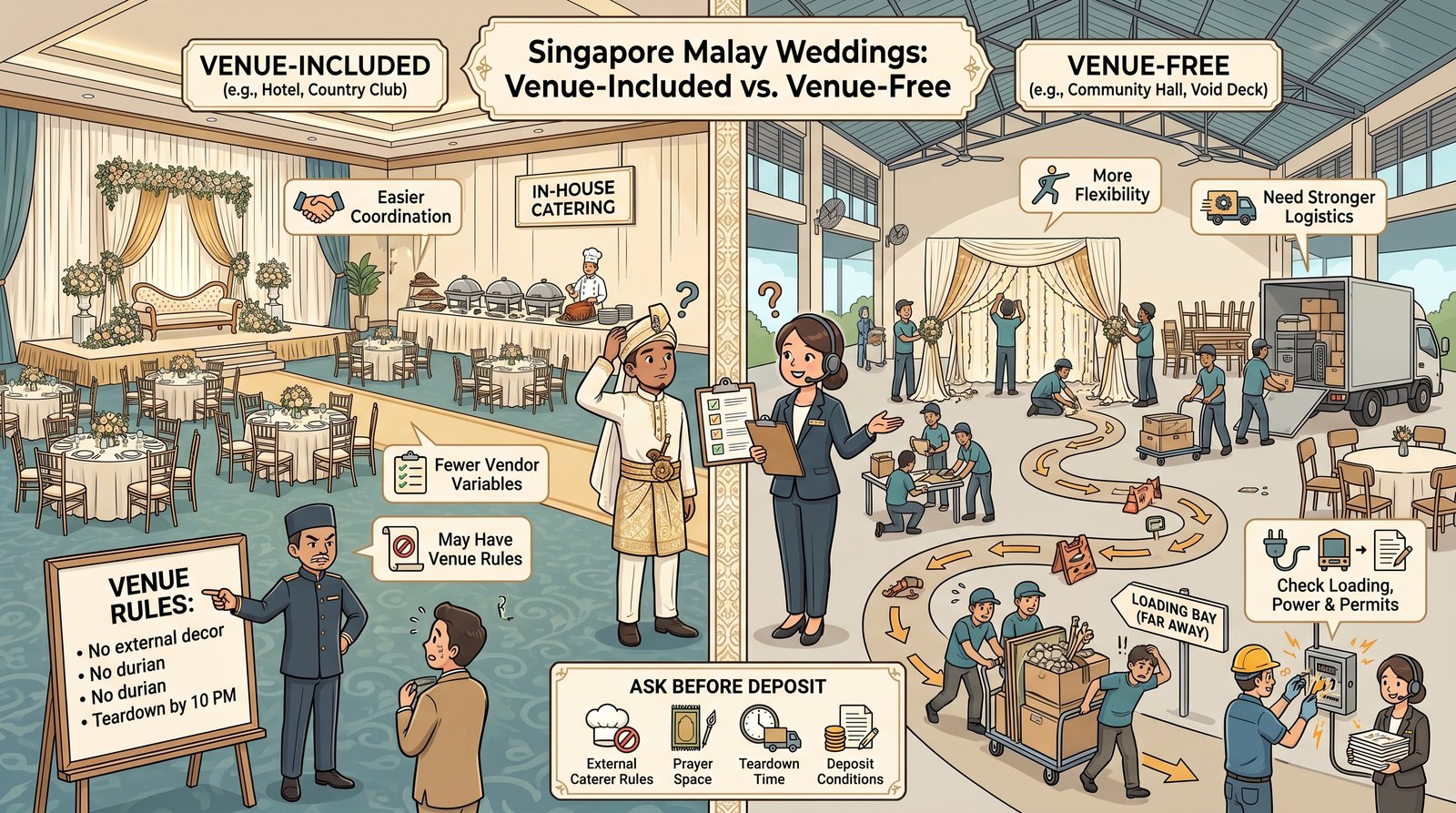
Venue-included means the space is part of the proposal, so the venue, the food flow, the decor, the timing and the vendor access can all be planned together. It suits couples who do not have a venue yet, who want fewer moving parts, who want one hand coordinating both the room and the day, or whose parents simply want a comfortable hall.
Venue-free means you already have the space, and the team builds the day around it, the decor, the food coordination, the andaman, the media and the day flow, but not the venue itself. It works well for a void deck, a community hall, a mosque room, a family home, a multi-purpose hall, a blank canvas, or a boutique hall you have booked yourself. Venue-free can save money, but only if the space is genuinely suitable. A cheap space that needs many rentals, permits, power support and extra crew may not stay cheap. The cost guide goes into how that adds up.
Halal food: check this before anything else
For a Muslim wedding, the food cannot be vague. Ask whether the caterer is MUIS halal-certified, whether the venue kitchen is certified, and, if the food is brought in, whether the venue even allows outside caterers and at what fee. Ask whether there is a pantry or holding area, whether there are limits on cooking, heating or live stations, and who is responsible for hygiene and clean-up. For anything to do with food, check the current status with MUIS rather than relying on word of mouth.
The wording matters here. "Halal-certified" should mean it can be verified. "Muslim-owned," "no pork no lard," and "halal-friendly" are not the same thing. This does not make a space impossible; it simply means the food arrangement has to be clear before you commit.
Prayer and wudhu access
A Malay Muslim wedding should respect solat timing, especially when the event crosses Zuhur, Asar or Maghrib. Check whether there is a clean prayer space, whether it is large enough for both men and women, and whether wudhu is nearby. Check that the route to the toilet or wudhu area is easy for elderly guests, that the schedule can pause properly for solat if needed, and that the bridal room is not too far from the prayer area. Not every venue has a perfect prayer room, but knowing early lets you plan respectfully.
Bridal room and privacy
The bridal room is not only for resting. It is used for andaman touch-ups, outfit changes, a break for the couple, family waiting, storing personal items, quick photos, and cooling down after the crowd. Ask whether the room is private, whether it has air-conditioning, a mirror and a power point, whether the toilet is nearby, whether the andaman can set up properly, and whether the bride can move from the room to the pelamin without walking through messy back areas. A weak bridal room makes the whole day more tiring for the pengantin.
Guest seating and the flow of the meal
For a Malay wedding, the flow of the meal is not a side issue; it is central. Check whether the venue can seat your guests comfortably, whether there is enough space between tables, and whether the elderly can move easily. Check that the buffet line does not block the entrance, that there is room to queue, and that the service crew can refill without pushing through guests. Look at where the drinks station sits, whether children and strollers have been considered, and whether there is a clear route for the couple's entrance. A good floor plan quietly prevents a dozen small headaches.
Loading, lift and vendor access
This is where many couples get caught. The decor, the pelamin, the catering, the sound, the furniture and the flowers all have to get into the space, and if access is poor, the setup gets slower and more expensive. Ask where the loading bay is and whether lorries can stop there, what time vendors can enter, whether there is a cargo lift and whether it is big enough for decor pieces, whether there are stairs, and how far the push is from loading to the room. Ask whether floor protection is required and what time vendors must clear out. For void decks and common spaces, check too whether vehicles can stop nearby without blocking residents or emergency access.
Power, water and sound
Do not assume the power is enough. Ask how many points are available and whether catering can draw from the same source as the sound and lighting, or whether extra power is needed. Ask whether water and a washing area are available, whether generators are allowed, what the sound limits are, and what time music must stop. Some town council common-area rules also mention charges for electricity and water points depending on the estate, so check your own.
Void deck and common-area weddings
Void deck weddings carry a lot of heart. For many Malay families in Singapore this is not a downgrade; it is memory, neighbourhood, gotong-royong and family warmth. But the booking side has to be handled properly. For HDB common areas, residents usually apply through the relevant town council or the channel it specifies. Some town councils route wedding and engagement bookings through LifeSG. The rules, charges, deposit and allowed timing differ by estate, so check before you plan around the space.
When you check, ask whether the applicant must be a resident, how early you can book, what deposit is needed, what the event hours are and when activities must stop. Ask whether electricity and water are available, whether tents are allowed, whether tables and chairs can stay overnight, and whether there are noise restrictions. Look around too: are there nearby blocks with elderly residents or babies, and is the area near a fire-engine route? Be considerate. A void deck wedding is shared with the whole block, and if residents feel disturbed, the mood of the majlis turns uneasy too.
Fire safety and temporary setup: do not guess
For ordinary religious events such as weddings and funerals, the SCDF Temporary Change of Use page lists religious events as examples that do not require Temporary Change of Use approval. That does not mean every setup is automatically fine. If your plan includes unusual temporary structures, very large tentage, a major stage, booth-like setups, a change in how the premises are used, or anything the venue flags as fire-safety sensitive, check with the venue, the land owner, the town council or the relevant authority early. The simple rule: if the setup changes the space in a big way, ask before you build.
Hidden venue costs to ask about
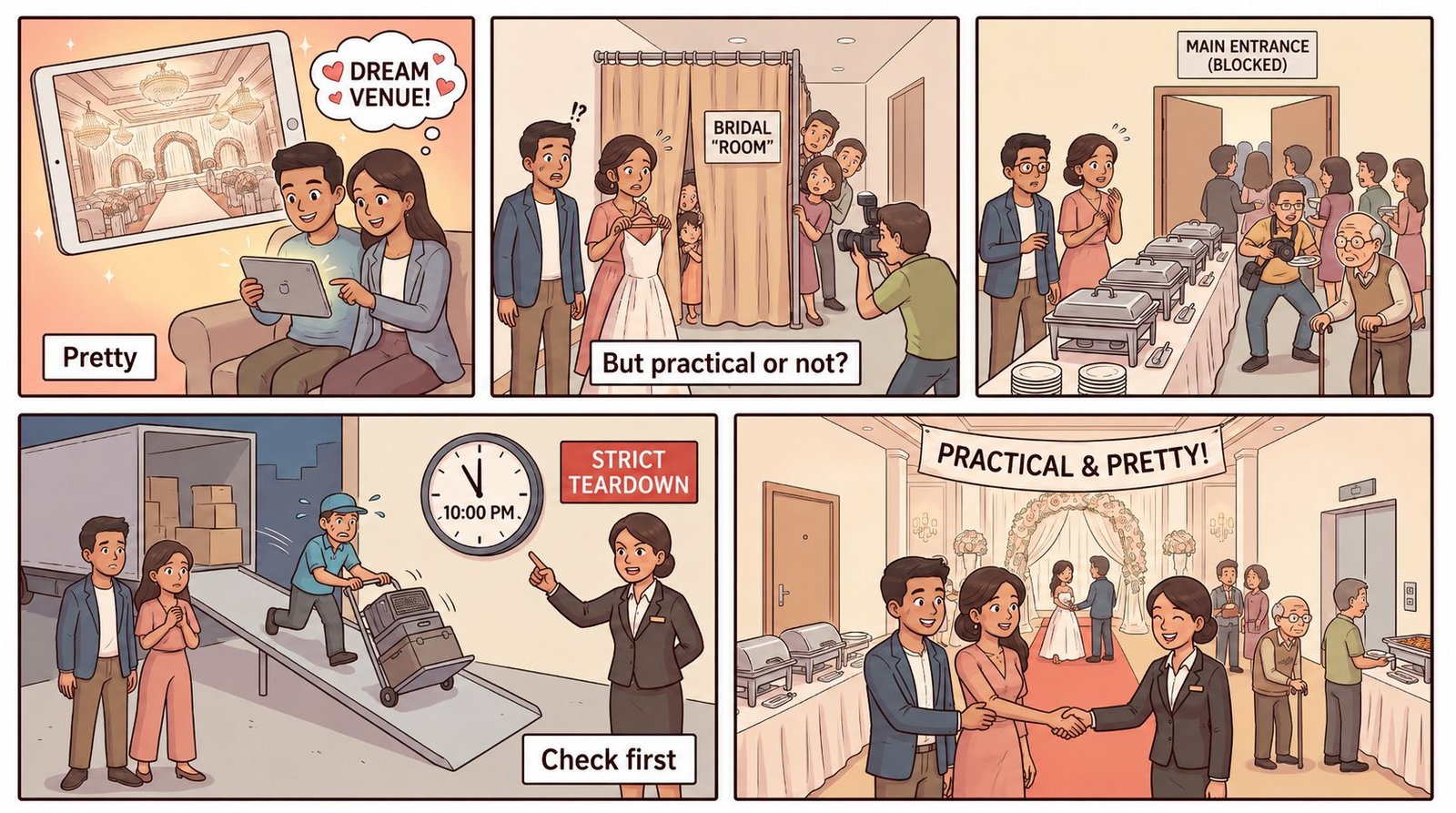
A venue that looks affordable can become expensive when every small thing is extra. Before any deposit, ask about the security deposit and cleaning fee, the external caterer and external decor fees, corkage or outside-vendor fees, overtime, early-setup and late-teardown charges, extra table or chair charges, AV, projector or screen charges, additional room charges, parking or valet, air-conditioning extension, and waste disposal.
The checklist to bring on a viewing
When you visit a space, walk it with this in hand.
Basic details
- Name, address, date availability
- Rental, setup and teardown hours
- Maximum guests, seated and standing capacity
Food
- Halal-certified kitchen or approved halal caterer
- External caterer allowed, food holding area, buffet location
- Water access and clean-up rules
Space
- Pelamin position, nikah area, guest seating
- Buffet queue, reception table, photo area
- Prayer space, bridal room, toilet access
Access
- Loading bay, cargo lift, passenger lift, stairs
- Parking, elderly access, wheelchair access
Rules
- Sound timing, decor and wall-hanging limits
- Open flame or cooking limits, confetti or bunga rampai rules
- Vendor insurance, permits, deposit terms
Comfort on the day
- Air-conditioning or ventilation, fan placement, a wet-weather plan
- Child-friendly movement, parent seating, a family photo area
- A place for gifts and berkat
What to send us if you already have a venue
If you have a space, send the venue name and address, the booking date and hours, the expected guest count, photos or a floor plan, the loading access, the power and water details, whether a halal caterer is required, whether external vendors are allowed, any venue rules or contract, and the kind of majlis you want. With that, we can tell you whether the space is ready, risky, or needs more planning before you commit.
Common questions
What is the best venue for a Malay wedding in Singapore?
There is no single best venue. A small akad may suit a mosque room or a home. A two hundred guest majlis may suit a hall. A five hundred guest wedding may need a large hall, void deck, ballroom or blank canvas. The best venue is the one that fits your guests, food flow, prayer needs and budget.
Can I hold a Malay wedding at a void deck?
Yes, many families still do. But you must check the booking, permit, timing, power, water, noise and setup rules with the relevant town council or booking channel for your estate.
What is venue-free planning?
Venue-free means you provide or book the venue, and the team handles the setup around it, the decor, food coordination, andaman, media, sound and day flow.
Should I book the venue or the team first?
If the venue is hard to get, shortlist early. But before any deposit, check whether it allows the halal food, decor, timing and guest flow you need. A wedding house can help you spot the red flags.
Which venue detail do couples forget most?
Loading and teardown. Couples look at the hall when it is empty and clean; vendors look at how everything gets in, where it goes, and how fast it must all leave.
Useful links
Continue reading from the Diari
Shape this around your own day.
Tell us your date, guest count, venue status and what your family cares about. We will turn it into a clear first proposal, insyaAllah.