
Diari · Renda Wedding House
Akad-Only, Nikah & Makan, or Full Majlis: Which Malay Wedding Format Should You Choose?
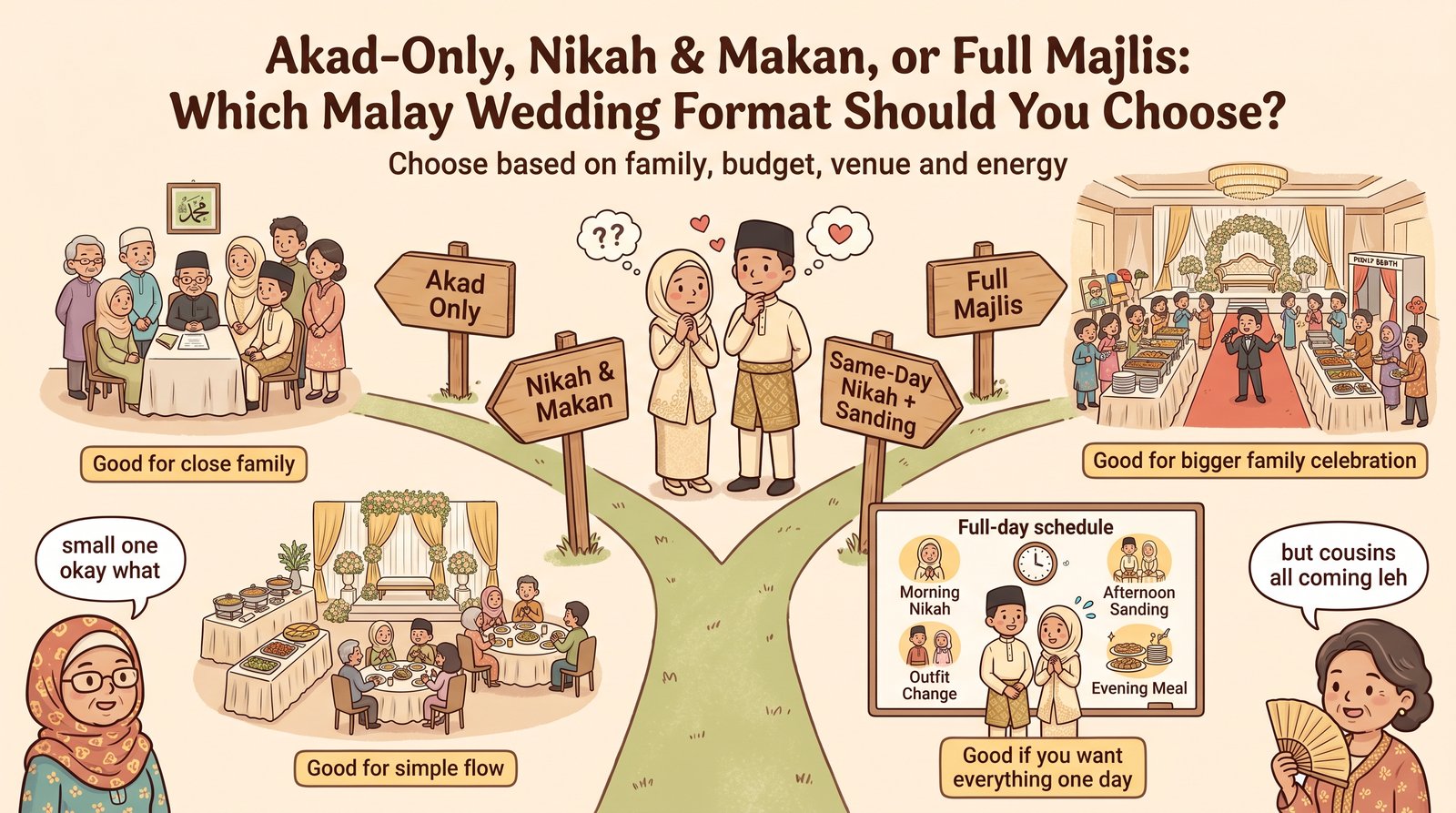
The short answer, so you can plan with a clear head: if you want a small, calm solemnisation for close family, hold an akad only. If you want that same quiet nikah but with a proper meal for the people who matter, do akad and makan. If you want the whole wedding in one day, hold the nikah and the bersanding together. And if both families want a larger celebration, with a full pelamin, a guest reception and the full run of adat, then it is a split-day wedding or a full majlis. The rest of this guide is how to find the one that is truly yours.
Most couples arrive at the same crossroads. One of you asks, quietly, whether you really need a full majlis. Then a parent asks the question that carries far more weight: nanti orang kata apa? Both are fair. A Malay wedding is never only about two people. It carries the family, the adat, the deen and the budget, and sometimes the opinion of every relative in the group chat. Choosing your format is really deciding how much of all that you want to carry, and choosing it on purpose rather than under pressure.
So before the colours and the pelamin, settle the shape. Get it right and everything after becomes easier: the venue, the food, the budget, even the conversations with your parents. Get it wrong and you spend months adjusting a day that never quite fit. This is the part a wedding house should carry for you, and it is where we like to start.
What must happen, and what you can shape
For a Muslim marriage in Singapore, one thing is fixed: the akad nikah. This is the solemnisation that makes the marriage valid in the deen and registered under the law. It is the only part of the day with a religious obligation. The bersanding, the hantaran, the berinai, the kompang: all of it is Malay adat, meaningful and often beautiful, but not what makes you husband and wife. A Muslim marriage is valid with the akad alone. That single fact gives most couples far more freedom than they realise.
A valid akad needs the right people present: the groom, the bride's wali, her consent, two witnesses, and a kadi to solemnise it, with the ijab kabul spoken clearly and the mas kahwin presented. The registration goes through the Registry of Muslim Marriages, ROMM. A few details are worth knowing early, because they shape your dates and not just your forms. You must give ROMM at least twenty-one days of notice before the solemnisation, and the application stays valid for about a hundred and fifty days once you submit. If one of you is a convert, settle the conversion card with Darul Arqam first. And if the marriage will also be recognised in Malaysia, Indonesia or Brunei, ROMM can issue a Letter of Recommendation. The exact steps and fees come from ROMM and do change, so confirm the current Muslim marriage process before you fix a date. If the paperwork feels like a lot, that is normal, and it is the kind of thing we handle with you.
Around that fixed centre, the rest is yours to shape. The question is not whether something is allowed. The question is which shape sits right with your family.
The five shapes a Malay wedding usually takes here
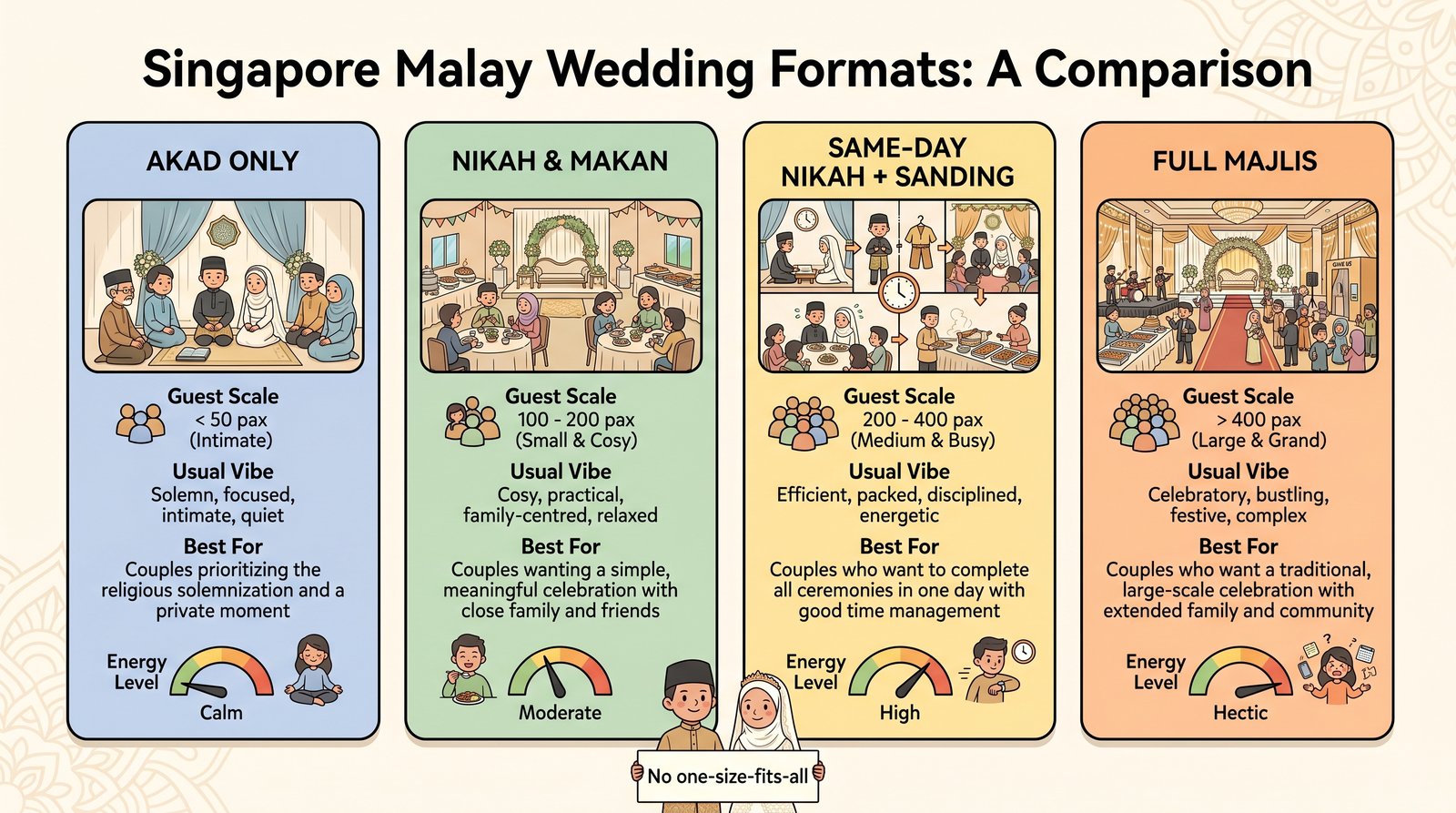
Most weddings settle into one of five shapes. Here they are at a glance, then we walk through each one and the single thing that decides whether it works.
| Format | Best for | Common pax | How it feels |
|---|---|---|---|
| Akad only | A small family and a simple nikah | 20 to 50 | Calm, intimate, focused |
| Akad and makan | Close family with a proper meal | 50 to 100 | Warm, simple, complete |
| Same-day nikah and bersanding | One full wedding day | 100 to 300 | Efficient, full, manageable |
| Split-day wedding | A private akad, a separate reception | 100 to 500 | More space, more logistics |
| Full majlis | A larger family and community | 200 and above | Traditional, lively, complete |
1. Akad only: small, valid, and unhurried
An akad only makes the solemnisation the whole event. You can hold it at home, in a mosque or surau room, in a small hall, or in a family space, with just enough around it to feel right: a simple nikah table or a small styled corner, light andaman for the bride, short photography to keep the memory, a little food for the family, and clear timing for the kadi. It suits couples who want the nikah to feel calm and unrushed, who would rather keep their savings for the home and the years after, and whose families already agree on keeping things small.
What makes or breaks an akad only is not money. It is family expectation. It works beautifully when both sides see it as a clear choice, not a quiet sign that a bigger majlis was out of reach. When you name the intention plainly, the small day feels full and deliberate. When you leave it unsaid, relatives tend to write their own version, and rarely the kind one.
2. Akad and makan: small, but it still feels like a wedding
For many couples today, this is the sweet spot. You hold the akad, then feed your family and close guests, usually with a small pelamin, a photo corner, a short program and a proper meal, but without a full reception. It fits the couple who wants more than a bare nikah but less than a hall: around fifty to a hundred guests, and a shorter, warmer day.
Here, what matters is the flow, not the scale. Even a small majlis needs the guest to know where to sit, when to eat, and where the photos happen. Small does not mean careless. Small should be tidy. A well-run hundred-guest akad and makan is remembered far more warmly than a loose, crowded one.
3. Same-day nikah and bersanding: one full day, one clean flow
For many Singapore families, this is the most practical choice. You hold the akad first, then move into the meal, the bersanding, the photographs, the greetings with family, and the send-off, all in one day. It works because everyone gathers once and every vendor mobilises once: the andaman, the photographer and the videographer cover the whole story in a single flow, the family blocks one day, and the couple is not stretched across two.
What makes or breaks the day is the schedule, because the akad time depends on the kadi and ROMM, and everything after has to breathe around the prayer times, the food and the guests arriving. Here is a sample shape, not a rule, just to picture it:
| Time | What happens |
|---|---|
| 9.00 am | Final vendor setup, family arrives |
| 10.00 am | Akad nikah |
| 10.45 am | Family photos, light refreshment |
| 11.30 am | Guest reception opens |
| 12.30 pm | Groom arrival, kompang if included |
| 1.00 pm | Bersanding and the meal |
| 2.00 pm | Family photos and guest greetings |
| 3.30 pm | Last guests, the couple rests |
| 4.00 pm | Event close, teardown begins |
Real timing always follows your kadi, the venue's rules, the prayer times, and how much adat you want to keep. The danger is asking too much of the clock. If you want full adat, several outfit changes, an outdoor shoot and a large reception in one day, you need a tighter plan and an honest conversation about what to set aside. Keeping that clock is our job, not yours.
4. Split-day: more room to breathe, more cost points
A split-day wedding puts the akad on one day and the reception on another, for example the nikah on Friday evening and the majlis on Saturday. It can be lovely. The akad stays private and unhurried, the reception gets its own moment, and parents often like that each part has space of its own.
But be clear-eyed about the cost. A split-day is not automatically cheaper. It usually means two days of andaman and grooming, two days of photography and video, two decor setups, two venue bookings, two catering arrangements, and the extra coordination of moving vendors twice. It is the right choice when the akad is meant to be private, when the reception venue's timing cannot meet ROMM's, or when the family genuinely wants two separate moments and the budget can carry it. Choose it for the reason, not for a saving that is not really there.
5. Full majlis: the classic celebration
The full majlis is the wedding most people picture: a full pelamin, a guest reception, a halal buffet, the kompang or a grand entrance, full styling, photography and video, an emcee to run the program, bunga manggar, berkat for the guests, and a larger team behind it all. It suits families with a wide circle, parents who want to invite their relatives and friends, and couples who want the full adat and the full reception, with the budget and venue to match.
A full majlis can be beautiful, and it can be exhausting when it is planned only around the couple's photographs. The real work is everything around the frame: the food queue, the elderly guests who need a seat and a clear path, the prayer space, the parking, the children moving through the crowd, and how long the couple can keep smiling under the lights. That last one is not a small thing. A majlis that looks after the guest and the elder is remembered as warm. One that only chases the album is remembered as long.
How to choose, honestly
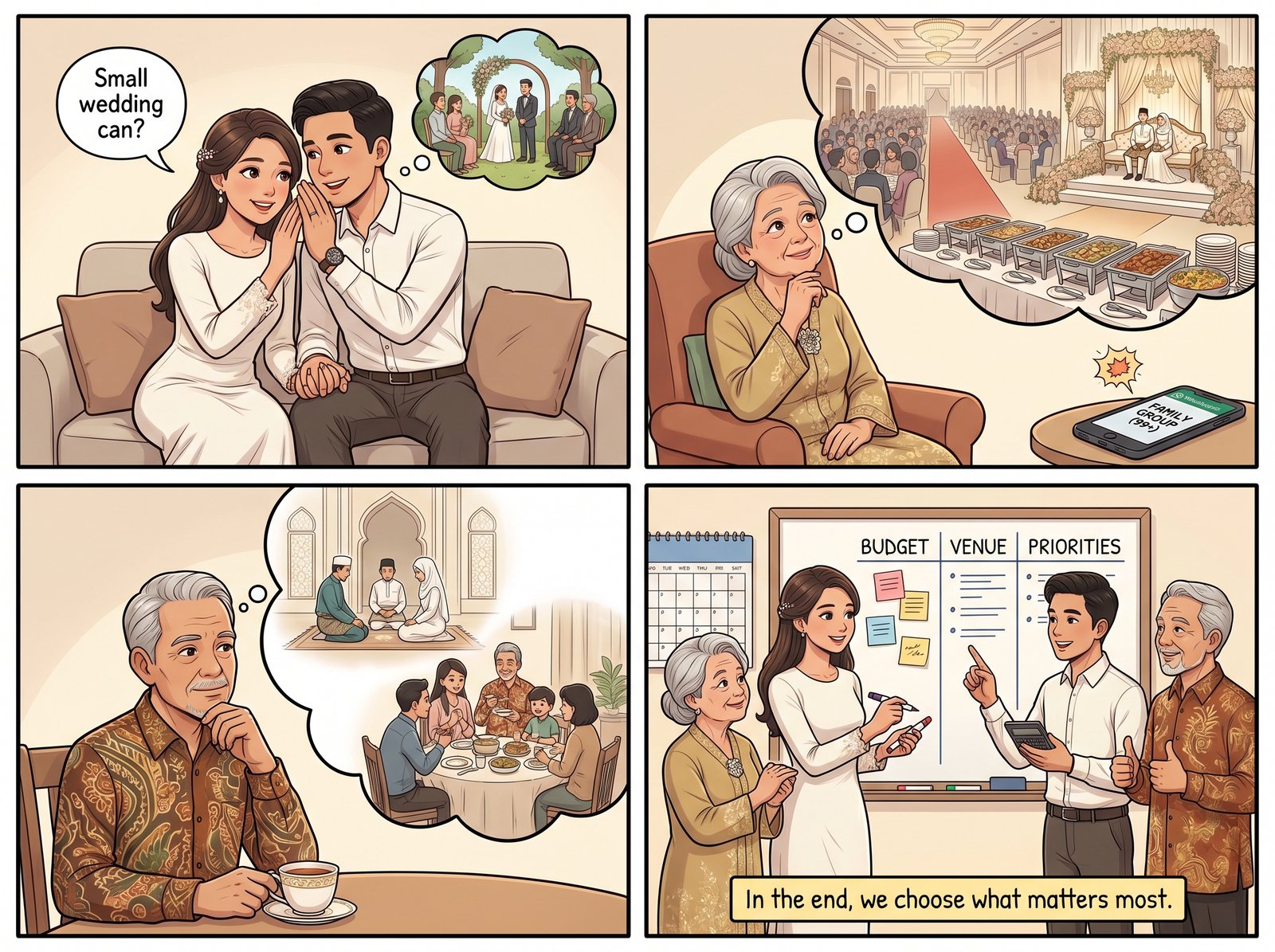
Sit down together first, just the two of you, and answer five honest questions. Not the polite answers. The real ones.
How many people must be there?
Not how many you know. How many must be there. A school group chat is not a guest list. If the number who must come is under fifty, an akad only may be plenty. Around a hundred, akad and makan fits well. Two hundred and above, you are into majlis planning, and the work scales with it.
What do your parents actually need?
Often parents do not need grandeur. They need to feel respected, and not to lose face in front of the people whose opinion they live with. So ask them plainly what matters most. Sometimes it is that certain relatives must be invited. Sometimes it is good food, or a proper pelamin, or family photographs, or one or two pieces of adat kept with care. Once you know the real need, you can meet it without building the whole wedding around a worry no one has actually named.
What can you pay without strain?
A wedding should not punish the marriage. Set an amount you can spend and still rest easy afterwards, then choose the shape that fits inside it with room to spare. If the budget is modest, choose the smaller shape with your head up. If it is comfortable, spend it on the family's ease and peace, not just on more decoration.
Do you have a venue, and how much adat do you want?
If you already have a space, the wedding can be shaped around it. If not, the venue and the production are best planned together. You can see the range of spaces a Malay wedding can live in, from void deck to hall to ballroom, on Renda Spaces. And be clear about adat. Some families want the kompang, the bunga manggar and the full sequence; others want a quiet, elegant nikah and a simple meal. Neither is more correct. The only real mistake is drifting into a shape by accident instead of choosing it with intent.
| If this is you | The shape that usually fits |
|---|---|
| We want it simple and valid | Akad only |
| We want close family and a proper meal | Akad and makan |
| We want one complete day | Same-day nikah and bersanding |
| We want a private akad first | Split-day wedding |
| Our parents have a long guest list | Full majlis |
| We already have a venue | A venue-free wedding shaped around your space |
| We are not sure yet | Start with a proposal conversation |
Where these days quietly go wrong
After many weddings, the same few regrets return, and almost all of them are avoidable. The first is packing too much into one day, then watching the schedule fall apart by the afternoon. The second is planning the whole majlis around the couple's photographs and forgetting the food queue, the elders, the prayer times and the parking, the things guests actually remember. The third is treating a split-day as a saving when it is really a comfort. And the fourth, the quiet one, is letting an akad only look like it was forced by money simply because no one said clearly that it was chosen on purpose. Name your shape, plan for the guest and the elder, and most of these never reach you. This is the kind of care we mean when we talk about how the house looks after your day.
Telling the family without a quarrel
The hardest part of choosing a format is rarely the choice. It is the table where you tell your parents. The instinct is to argue, or to give in. Both are tiring, and neither works well. What works is naming your intention with respect, so the elders feel honoured rather than overruled. Their blessing, the restu, still carries real weight in a Malay family, and it should.
One sentence like this has saved many couples many long meetings: we want the nikah calm and meaningful, we will keep it proper, feed the family well, and make sure the photographs are nice, we just do not want the day to be bigger than what we can carry. Say it warmly, and mean it. Most parents soften, because what they were really asking for was care, not size.
What to have ready before you speak to us
When you are ready to talk to a wedding house, a little preparation makes the first conversation easy. Have a rough date or month, a rough guest count, your venue status, the format you are leaning towards, any must-have adat, the budget you are comfortable with, the part of Singapore you are in, and any notes on prayer, ablution, elderly or accessibility needs. There is no need to write an essay. Our Begin page asks for these gently, just enough to start. If you would rather see the broad lanes first, Renda Journeys lays them out as The Akad, The Hall and The Grand.
Common questions
Is an akad only enough for a Malay wedding?
Religiously and legally, the akad nikah is the part that matters; once it is done properly, you are married. A Muslim marriage is valid with the akad alone. The rest is family expectation, and an akad only is more than enough when both families agree and the day is kept warm and respectful.
Can we hold the nikah and bersanding on the same day?
Yes, and many couples do, because everyone gathers once and the vendors mobilise once. It rests on timing: the kadi and ROMM slot, the andaman, the meal, the guests arriving and the photo flow all have to line up, so plan the clock with care.
Is akad and makan cheaper than a full majlis?
Usually, because the guest count and the production are smaller. But the final cost still depends on the venue, the food, the decor, the styling, and whether you add video or extra portraits, so a small wedding with heavy additions can still climb.
Should we split the akad and bersanding across two days?
A split-day gives more room to breathe, but it can cost more because some vendors come twice. It is the right call when the family wants a private akad, or when the reception venue's timing cannot meet ROMM's.
Which format is easiest for families?
For most, a one-day nikah and bersanding is easiest, because everyone comes once and the vendors mobilise once. For very small families, akad and makan can be calmer still.
Useful links
Continue reading from the Diari
Shape this around your own day.
Tell us your date, guest count, venue status and what your family cares about. We will turn it into a clear first proposal, insyaAllah.